


By Jeremy Wagstaff
(this is a longer version of an upcoming syndicated column.)
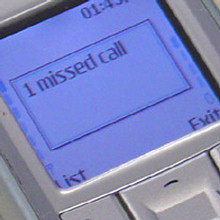
When people look back at the last decade for a technology zeitgeist they may choose SMS, or the iPod, or maybe even Facebook. Me? I’d choose the cellphone call that rings, briefly, and then is silent.
It’s one of those social phenomena that has so embedded itself in the culture that we don’t even notice it. It developed its own syntax, its own meaning, and even shifted the boundaries of cultural mores and social intercourse. Even I didn’t realise it was so widespread until I started researching this article. And yet, at least in the middle of the decade, it spanned all continents and was accounting for more than half of cellphone traffic in many developing countries.
So what is the miscall and why is it—was it–so big? The miscall is simple: I call your cellphone but hang up before you pick up. Instead of you thinking there’s a mistake, you know exactly why I called, and either call me back, or don’t, depending on how we’ve agreed on what the miscall means. It’s a form of communication that requires no words, no speech, and, most importantly, no expense. At least for you and me. Not, sadly, for the cellphone operator.
But initially cellphone operators weren’t too bothered.
There’s a temptation, after all, to regard the miscall as a poverty thing, done by poor people. I don’t have any money; you have money, so you call me. Indeed, in Ethiopia it’s called miskin—Amharic, deriving from the Arabic for “poorest of the poor”, with a distinct connotation of being worthy of pity. And among youth the lure of the cellphone is matched only by the limits on a budget. So, someone somewhere is going to call back, so money will be spent on a call, somehow.
But two researchers for Norway-based Telenor Hanne Geirbo and Per Helmersen found that was only part of the picture, even in a place like Bangladesh. Combing the data from a single day of Grameenphone’s traffic, they concluded that “the charged traffic generated from an initial missed call is minimal compared o the missed call activity.” In short, a missed call didn’t result in a real call.
This was communication in itself, not just a plea for communication.
Not only that: making the missed call was so easy—hit the green button, wait for a ring and then hit red—that it was stopping other services, like SMS, from getting any traction. And we’re not talking small potatoes here: Missed calls constituted upwards of 70% of Grameenphone’s total network traffic in any hour. Some people were sending miss call after miss call, one after the other—100, or even several hundred, miscalls in a short period. This, in the words of the researchers, was “a major cause of congestion at peak periods,” leading to calls disconnected, or not being connected in the first place. In 2005 one Kenyan cellular network estimated that four million miscalls were being made daily on its network.
A miscall, then, is a lot more than a call me back thing. It’s a fast way to communicate a key piece of information to someone who is already expecting it around that time, and only needs to be activated: “I’m home, throw the gate keys down.” The timing is the context that gives the unspoken, unwritten message meaning: A miscall at 6 pm may mean I just left work.
And, if there isn’t any specific time context it may just mean: “I’m missing you.”
Then there’s the another parameter: how many missed calls are made can vary the message. Two missed calls means “I’m running late” or “I’m at home, where are you?” depending, it would seem, on what part of Bangladesh you’re in. In Syria five missed calls in rapid succession means “I’m online, let’s chat.” There are business uses too: Farmers in Bhutan, according to UNCTAD’s annual Information Economy Report published in October, know how much milk their customers want by the number of miscalls. They then miscall the customer back within 15 minutes; no miscall means no stock. Researchers in India, where miscalls accounted for about 40% of all calls, found that the miscall was used by print and ticketing shops to let their customers know their orders were ready.
Missed calls can be fun if you don’t have much else going on in your life. Try to irritate your friends by miscalling them; if someone is doing it to you, try to pick up before they hang up, losing them credit and the game. This may sound inane, but these calls are likely to be serious network congesters. If the power goes off, the researchers found, Bangladeshis would entertain themselves by miscalling friends, relatives, and even complete strangers. The researchers found one young woman met her boyfriend that way. If you call communicating only by cellphone a relationship. Who said blackouts couldn’t be fun?
Talking of flirting, missed calls can create a private space between two people who couldn’t otherwise connect without fear of exposure or ridicule. One 44-year old Bangladeshi admitted to expressing his love by sending the object of his affections hundreds of miscalls. In Damascus it’s no different: One young man proudly explained to a journalist from Syria’s Forward Magazine last year that he sometimes gets 250 miscalls from his girlfriend. Young couples in a relationship miscall each other to check the line is free or to keep the line busy—either way ensuring their paramour is not otherwise engaged, so to speak. Starting to feel sorry for the network operator yet?
Husbands expect calls from spouses at fixed times as signals that the house is running smoothly. Children check in with their parents. Newly married women get their mothers to call without incurring the wrath of their mothers-in-law. Friends miscall a member of their circle who couldn’t make their evening out, as if to say: we’re missing you.
There are rules, of course, about who one can and cannot miscall. No one below you in the hierarchy, either in the family, the office, or the community (one man is quoted as specifying “driver and electricians…it’s a matter of prestige.” And don’t miscall your teacher or your boss. At least in Bangladesh. in Africa, where it’s called variously “flashing” and “biper”, there are complex rules about who can be flashed. Among friends, one commenter on a Nigerian blog said, it’s about exclusion: with miscalls “there is complete communication beyond the scope of outsiders.”
In other words, the missed call is not some reflection of not having enough credit. It’s a medium of exchange of complex messages that has become surprisingly refined in a short period. Much of it is not communication at all, at least in terms of actual information. It’s what the researchers identify as phatic communication: where the interaction is the motivation not the content of the message itself. Or, as a Filipino professor, Adrian Remodo put it to a language conference in Manila in 2007 at which they votedfto make miscall, or miskol in Tagalog, the word of the year: A miskol is often used as “an alternative way to make someone’s presence felt.”
Indeed, the fact that the message itself has no content is part of its beauty. Just as the SMS is confined to 160 characters—meaning it can either be pithy or ambiguous, depending on the effect you’re looking for—so can the missed call be open to all kinds of interpretation. A lover receiving a missed call can fill her evening contemplating what was meant by those few unanswered rings.
The Telenor researchers speak of how this “practice contains valuable information about the communication needs and preferences of our customers.” Very true. But one gets the feeling that their call for more research to “provide the telecom industry with a much-needed window into the socio-cultural life space of our customers , and suggest new service offerings that better match their needs and circumstances” may have fallen on deaf ears.
I’ve not found much evidence of this, and that was written back in 2008. Some African cell providers gave away five free “Please call me” text messages to each subscriber. A Swiss company called Sicap has had some success in Africa with a service called Pay4Me, which is a sort of reverse charge call for mobile phones. The only difference I can see between this and the miscall is that the callee doesn’t have to make the call, so to speak. That, and the fact that most prepaid services nowadays don’t let you make a call if you have a zero balance—which accounts for 30% of African users, and 20% of Indian cellphone users, according to Telenity, one company hoping to offer the callback service.
Telcos in Afghanistan offer polling services where respondents, instead of texting back their answers, miscall a number depending on their choice of answer. More creatively, some socially minded organisations have used the miscall as a cheap way to communicate: Happypill, for example reminds you to take medication if you fail to miscall them at an appointed time each day.
The point is that while usage may vary it’s common in many countries—and has been for much of the past decade. As soon as mobile phones came with prepaid vouchers, and operators included the name and number of the caller on the handset display, so did the opportunity arise for someone to pay for your call. In France and in French-speaking Africa it’s called “un bip”, I’m told, and one commenter said that it’s included in some prepaid packages. In Iran it’s called “tak”; in Australia “prank” and in the U.S. “drop call”. In Italy, apparently, it’s called “squillo” and in Oman a “ranah” (where there’s even a pop song based on the practice).
And it goes further back than that: “Call me and hang up when you arrive,” my mum used to say to her impoverished student son.
Of course, there are reasons to be concerned about this. One Indian columnist wrote:
What, then, will happen to the human voice? If two rings on the mobile are sufficient to say “I miss you”, what will become of the impassioned verses that poets have so far written to appease their beloved? I wonder how a dialogue will sound in a world where voices have become ringtones.
It may be that the miss call culture is in decline. Jonathan Donner, a Microsoft researcher who has looked into this phenomenon more than most, noted back in 2007 a “beep fatigue”, leading some to turn off their caller ID function and ditch phone numbers that clearly indicate they are on a postpaid package. And in some places where the costs of a call and an SMS have fallen to pretty much nothing, the appeal of the miscall has waned in some places.
An SMS would work, but requires typing, and in a place like Bangladesh, where more than half the population is illiterate that’s not a popular option. And text messages sometimes take a couple of minutes to arrive: a call is immediate—something that’s apparently important to my Filipino friends.
Then there’s the fact that the missed call can be discreet in a way that a phone call, or an SMS, can’t be. You could make a miscall from inside one’s bag or pocket (and I frequently do, though that’s by accident.) Which may explain why, a student in Pakistan wrote earlier this year:
what amazes me the most is unlike other fads such as texting obsessively etc have gone away pretty quick ,this ‘miss call’ culture still reigns supreme in most of our society.
My tupennies’ worth? As the SMS, which created its own culture out of the limitations of what was not supposed to be a commercial service, so has the miscall created its own norms. Whether these survive the next decade is unlikely. But we should watch these things carefully, not because they represent commercial opportunities—we’re bound to mess that up—but because they speak volumes about the inventiveness of the human spirit, and its ability to squeeze rich new forms of communication out of something that, on the surface, seems to be nothing—a briefly ringing, and unanswered phone.